If you’ve ever watched a law enforcement officer move smoothly through a chaotic call for service, or a security professional grab essential tools in a split second during an emergency, you’ve been watching duty gear at work. As someone who’s been supplying duty gear for over 12 years, I’ve seen first-hand how this isn’t just a collection of belts, pouches, and tools—it’s the backbone of someone’s ability to do their job safely and effectively. Too often, people dismiss duty gear as “uniform accessories” or “off-the-shelf equipment,” but the reality is far more nuanced, and getting it right can mean the difference between an officer staying focused on their work and fumbling for a tool when every second counts. Duty Gear

Let’s start with the basics: what even is duty gear? At its core, duty gear (sometimes called duty belt gear, tactical duty gear, or field duty gear) is a standardized, modular system of equipment designed for frontline personnel—law enforcement officers, correctional staff, security guards, first responders, and even some military personnel working in support roles. It’s worn on a belt system, typically around the waist, and carries every tool someone needs to perform their daily duties and handle unexpected incidents. Unlike hunting gear or military assault gear, which are built for specific mission types, duty gear is versatile enough for 12-hour shifts, routine patrols, and everything from minor traffic stops to life-threatening emergencies.
A common misconception is that duty gear is just a heavy, bulky belt with a bunch of pouches stapled on. Early generations of duty gear were exactly that: thick leather belts that would dig into an officer’s hips after a few hours, pouches that fell off mid-patrol, and tools that were impossible to access in a hurry. I remember when I first got into the industry in 2011, many officers would skip updating their gear because they thought all it took was a trip to a local uniform store to grab whatever was in stock. That outdated approach is one of the reasons we started our supply business—frontline personnel don’t have time to deal with gear that fails when they need it most.
Modern duty gear is built on three key principles: durability, accessibility, and ergonomics. Let’s break each of these down because they’re not just buzzwords—they’re non-negotiable for anyone relying on this equipment. Durability is the foundation. Duty gear is exposed to rain, snow, mud, constant wear and tear, and even accidental drops. That’s why the best duty gear materials are things like reinforced nylon, high-tensile polymer, and top-grain leather (for those who prefer it)—materials that don’t crack, fray, or stretch out of shape after months of use. When we source gear, we test every batch for weight capacity, tear resistance, and UV stability, because an officer shouldn’t have to replace their duty belt after six months of patrolling sun-heated streets in Arizona.
Accessibility is the second principle, and it’s where modular design comes in. A properly set up duty belt should let you draw your sidearm, reach your handcuffs, or grab your radio without looking down or fumbling. That means pouches are positioned in specific, ergonomic spots—handcuffs on the dominant hand side, taser or pepper spray within easy reach of the weak hand, and spare magazines close to the center of the belt for quick access. Modularity is key here too: no two officers have the same needs. A patrol officer might need a first aid pouch and a portable radio, while a correctional officer might need a specific set of restraints and a key pouch for cell blocks. Modular gear lets you mix and match components to fit individual roles, rather than forcing every person to carry the same exact loadout.
Ergonomics is the third, and often most overlooked, principle. A duty belt can weigh anywhere from 15 to 30 pounds when fully loaded—if it’s not fitted properly, that weight puts constant strain on the lower back, hips, and shoulders, leading to chronic pain over time. That’s why good duty gear systems include features like a padded inner belt (often made of neoprene or breathable mesh) that takes the weight off the main belt, which is usually made of stiffer, more durable material. We’ve had so many officers tell us that switching to a properly ergonomic belt eliminated the lower back pain they’d dealt with for years, and that’s why ergonomics is something we prioritize in every product we supply.
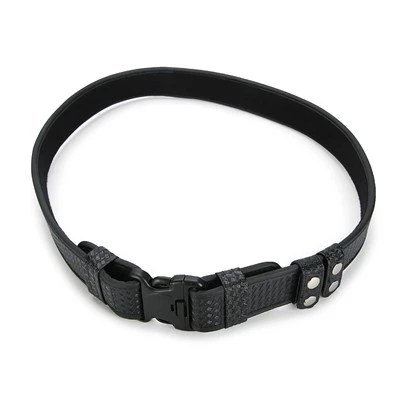
Now, let’s talk about the components that make up a full duty gear setup, because each part serves a specific purpose, and cutting corners on any one part can create a problem. The foundation is the belt system itself: the inner belt and outer belt. The inner belt is the one worn directly against the skin, padded and breathable, designed to hold the outer belt in place without digging into your hips. The outer belt is the stiffer, load-bearing part that holds all your pouches and tools. Cheap duty belts often skip the inner belt, leading to a belt that slides around and causes discomfort.
Next, the core tools that every duty gear system includes. Most setups have a sidearm pouch, sized and positioned to let you draw your weapon in under two seconds. Then there are restraints: handcuff pouches, which should be secure but easy to open with one hand, and for some roles, leg restraints or other specialized tools. For non-lethal tools, pepper spray or OC spray pouches, taser or conducted energy device holders, and batons or expandable baton pouches are standard. Communications are another key component: radio pouches sized to fit different radio models, and often a cable management system to keep earpiece wires from getting tangled. Less-lethal first aid is also essential: tourniquet pouches, trauma dressings, and sometimes Naloxone for opioid overdoses, depending on the region and role.
Over the years, we’ve seen huge shifts in what’s included in duty gear setups. Ten years ago, it was rare to see a tourniquet on a duty belt; now, it’s a standard component after research showed that life-saving trauma care in the first few minutes can drastically improve outcomes. Similarly, many officers now carry body cam accessories that integrate with their duty gear, so the camera is always positioned correctly and doesn’t get knocked off during a call. These changes aren’t just random—they’re driven by feedback from the people actually using the gear, and that’s a big part of how we design our products.
One mistake we see a lot is people buying duty gear that’s too generic. A security guard working at a mall has different needs than a highway patrol officer who works in rural areas with rough terrain. The mall guard might need extra key pouches for entry points and a smaller radio, while the highway patrol officer needs a duty gear system that can handle being worn in a patrol car, and maybe a reflective vest integrated into the setup for nighttime traffic stops. That’s why we work directly with our clients to assess their specific role, environment, and needs, rather than just selling them a pre-assembled belt that doesn’t fit their daily work.
I’ve spent countless hours talking to frontline personnel about their gear, and one story sticks with me. A corrections officer named Jake told me that his old duty belt had a handcuff pouch that was positioned too low, so every time he bent down to unlock a cell, the handcuffs would bang against the cell bars. After he switched to our modular setup, he adjusted the pouch to sit higher, and he said it made his shift so much easier—no more constant banging, and he could grab his handcuffs faster when he needed to respond to a cell disturbance. That’s the impact good duty gear has: it’s not about having the fanciest parts, it’s about designing gear that works with the person using it, not against them.
Another common question we get is about maintenance. Duty gear isn’t a “set it and forget it” purchase. Every few months, you should inspect your gear for frayed straps, loose stitching, or cracked pouches. Leather belts need to be conditioned to keep them from drying out, while nylon gear can be wiped down with mild soap and water. We always tell our clients that replacing a worn part of their duty gear is cheaper and safer than waiting for it to fail mid-shift. Too many people wait until a pouch breaks to replace it, but that’s a risk no one should take when they’re relying on their gear to keep them safe.
As a supplier of duty gear, our job isn’t just to sell belts and pouches—it’s to understand the unique challenges of frontline work. We work with law enforcement agencies, private security firms, correctional facilities, and first responder teams, and every client has different needs. Some need gear that’s compliant with national or industry standards, like those set by the National Tactical Officers Association, while others need specialized gear for harsh environments, like desert or arctic regions. We source our products from manufacturers who test their gear to meet these standards, because we know that when an officer is in a dangerous situation, their gear has to perform.
If you’re outfitting a new team, replacing old gear, or just looking to upgrade your current setup, there’s a lot to consider. You don’t have to figure it out alone. We specialize in custom duty gear solutions tailored to your specific role, whether you’re a new patrol officer just starting out, a seasoned correctional supervisor, or a security company looking to outfit an entire team. We don’t push generic products that don’t fit, and we stand behind every piece of gear we supply because we know how much it matters to the people who wear it.
If you’re ready to upgrade your duty gear or outfit your team for safety and efficiency, reach out to us to discuss your needs. We can walk you through the different options, help you design a setup that works for your role and environment, and make sure you have the gear you need to perform your job confidently, shift after shift.
Gunbags References:
- National Tactical Officers Association. (2020). Duty Gear Standards and Best Practices for Law Enforcement.
- Occupational Safety and Health Administration. (2021). Ergonomic Guidelines for Uniformed Personnel Load Bearing Equipment.
- International Association of Chiefs of Police. (2019). Modern Duty Gear: Evolution, Design, and Application for Frontline Officers.
- Journal of Emergency Medical Services. (2022). Trauma Response on Patrol: The Role of Duty Gear in Pre-Hospital Care.
Quanzhou Jinbei Bags Co., Ltd.
As one of the most professional duty gear manufacturers and suppliers in China, we have world-leading production equipment and strong manufacturing capabilities. Please feel free to buy bulk high quality duty gear for sale here from our factory. Customized orders are welcome.
Address: 302, NO. 158-17, EAST DISTRICT, TANDING, HESHI, LUOJIANG , QUANZHOU, FUJIAN, CHINA
E-mail: jinbeibags@126.com
WebSite: https://www.jinbeibags.com/
